By Or Rahamim,
In the past 90 days, a client’s YouTube channel crossed 53,000 views. That’s a healthy number, but the interesting part wasn’t the total – it was where those views came from.
Over 67% of traffic originated from external sources. Google Search alone accounted for nearly 47% – more than 25,000 views.
Almost half of their YouTube audience didn’t find them on YouTube. They found them on Google.
This isn’t an anomaly. It’s a signal worth unpacking.
Google Search Is Outperforming YouTube Search
Traffic from Google Search was 2.3 times higher than from YouTube’s own search (25K vs 11K views). That ratio tells a story.
The client’s content isn’t just living inside YouTube’s ecosystem – it’s being pulled directly into Google’s search layer. They’re capturing users earlier in the journey, at high-intent, research-heavy moments. And their videos, when optimized correctly, are behaving like search content rather than social or entertainment media.
This aligns with a broader pattern we’ve been tracking: Google is increasingly favoring video as a direct answer format. Recent analysis from Search Engine Land confirms that YouTube videos are surfacing more prominently in AI Overviews – not as embedded carousels or add-ons, but as cited sources within AI-generated responses.
That’s not a cosmetic UX change. It’s a reallocation of visibility.
The January Inflection Point
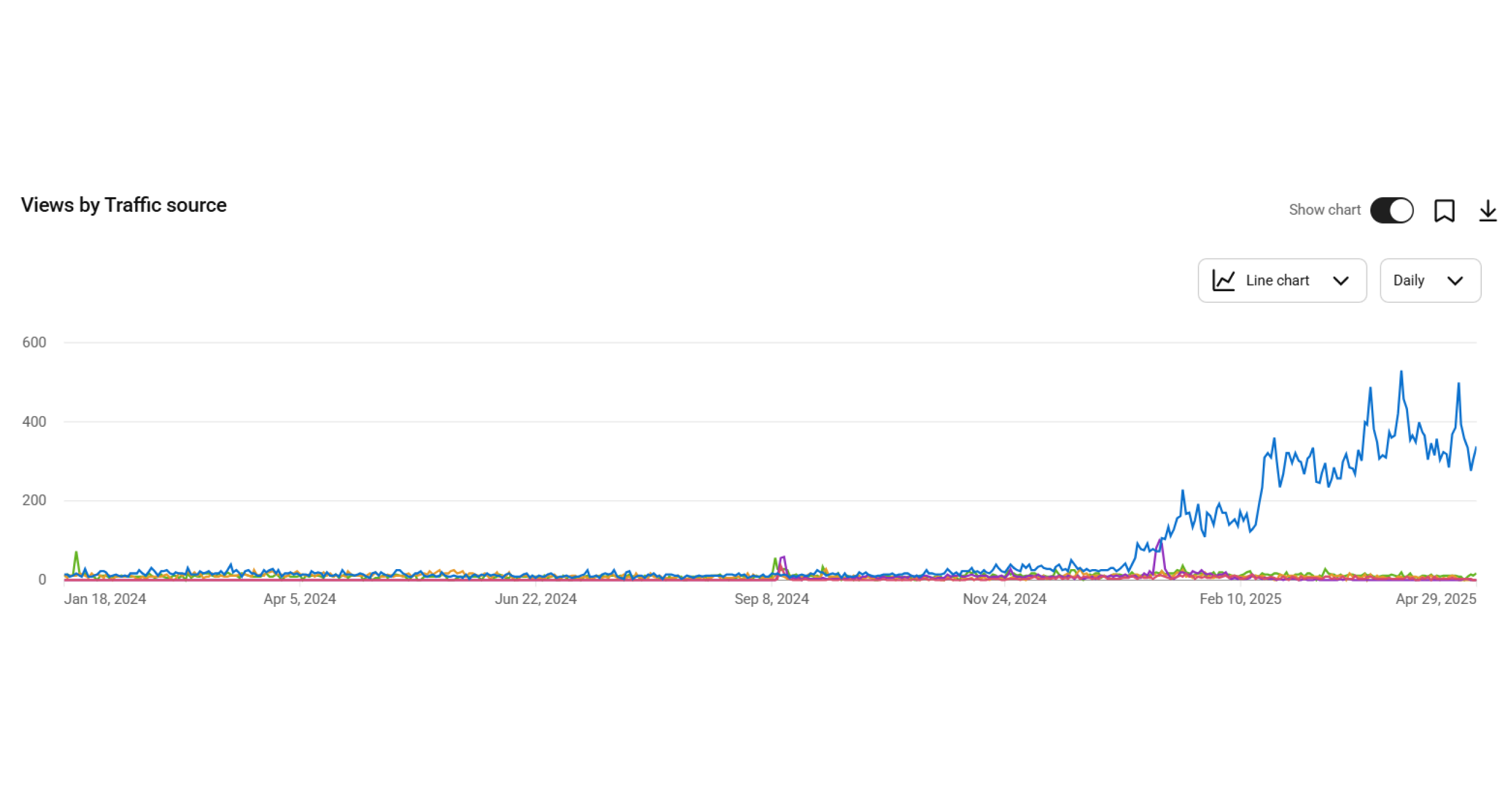
Looking at the traffic data, there’s a sharp uptick around January 2025. Google referrals spiked while YouTube Search and other sources stayed flat.
That inflection point corresponds almost perfectly with Google’s broadened rollout of AI Overviews – when the search results page began synthesizing information and pulling video references directly into generative summaries.
[Image: Traffic graph showing Google Search referrals spike in January 2025] – attached to the folder
We believe the client’s content is now surfacing as a supporting reference in AIO answers, which would explain the surge in Google-driven YouTube traffic.
Two implications here. First, discovery is now multi-modal – your audience might find your brand through AI-generated summaries that embed or cite video. Second, optimization extends beyond YouTube. The metadata, structure, and narrative clarity of your videos now affect whether they get indexed, cited, and surfaced in search.
Why Video Resists the AI Compression Problem
For years, YouTube has been the web’s largest video library. Now it’s quietly becoming one of Google’s most powerful SERP players – especially for queries that demand explanation, demonstration, or storytelling.
We’re seeing it in education, product reviews, and thought leadership. These are spaces where users want more than quick facts. They want clarity, depth, and human presence.
Here’s why this matters strategically:
Video resists commoditization. Text can be summarized, paraphrased, and replicated. Video carries tone, timing, and intent – attributes AI can reference but not easily replace. When AI Overviews compress your written content into a summary box, your words get absorbed. When they cite your video, your voice stays intact.
Engagement runs deeper. A blog skim lasts seconds. A well-structured video holds attention for minutes. That’s time for your story to land and your brand to register.
Visual narrative cuts through sameness. As AI summaries standardize information, the differentiation shifts to format. Video is one of the last mediums where your message arrives unfiltered.
What This Means for Your Strategy
We talk often about Generative Engine Optimization – influencing how AI systems retrieve, synthesize, and cite information. YouTube is now a grounding source in that ecosystem.
For Google’s AI, a high-quality, well-labeled, context-rich video isn’t just content. It’s evidence.
A few shifts worth making:
Optimize for Google, not just YouTube. Craft titles, descriptions, and timestamps around real search intent, not trending tags. Think about what someone types into Google, not what’s performing on YouTube’s homepage.
Design for AIO appearance. Your thumbnail, first 15 seconds, and description are now potential citation snippets. They need to work as standalone previews, not just click hooks.
Integrate YouTube into your SEO stack. Treat it as part of your search presence, not a separate channel with separate metrics. The silo between “SEO” and “video strategy” no longer reflects how discovery actually works.
We’re now building this into client strategies from the start – not as a video add-on, but as core search infrastructure.
The Convergence Advantage
If this trend continues – and all signals suggest it will – the brands that benefit are those building across both search and video simultaneously.
AI systems increasingly prefer trusted, engaging, and verifiable sources. Google’s algorithms already treat YouTube as a first-party authority. The best-performing videos aren’t viral – they’re valuable.
For teams investing in both SEO and video, this convergence is a genuine edge. It rewards depth, storytelling, and substance over format-specific tricks.
The SERP of the future won’t just list results. It will show and narrate them. And as that happens, YouTube becomes one of the most strategic assets in your GEO toolkit.
The question isn’t whether video belongs in your search plan. It’s how fast you can make it central.
If you’re rethinking how video fits into your organic strategy, let’s talk. Connect with me on LinkedIn – I share what we’re learning from real client work.