The Challenge: Google Search Console Sampling and Inaccurate Traffic Calculation
When analyzing organic traffic, distinguishing between branded and non-branded traffic is key for understanding your SEO performance. Google Search Console (GSC) provides valuable insights, but its sampling method poses a challenge. GSC only shows a subset of total queries, and this sampling can lead to incomplete data, especially when trying to calculate the split between branded and non-branded traffic.
Why Filtering Queries in GSC Leads to Inaccurate Results
To calculate branded vs. non-branded traffic in GSC, many SEOs rely on filtering queries:
- Branded queries: Including the brand name or variations.
- Non-branded queries: Excluding the brand name.
However, because GSC samples data, this method introduces errors:
- The branded filter shows only a subset of branded queries.
- The non-branded filter removes branded queries but still suffers from incomplete sampling.
This results in a lower sum of branded and non-branded clicks, often much lower than the total clicks reported by GSC, which causes discrepancies in the analysis.
Example: How GSC’s Sampling Affects the Traffic Calculation
Let’s look at a real example to see how the filtering method causes inaccuracies:
- Total clicks reported by GSC: 188K

- Branded clicks (via filter): 32K

- Non-branded clicks (via filter): 85.5K

If the filtering method worked accurately, the sum of branded and non-branded clicks would equal the total: 32K + 85.5K = 117.5K
But GSC reports 188K clicks, leaving a 70.5K gap unaccounted for. This gap occurs because GSC samples data and excludes certain queries in its filters, resulting in incomplete insights.
The Better Way: A More Accurate Method for Estimating Non-Branded Traffic
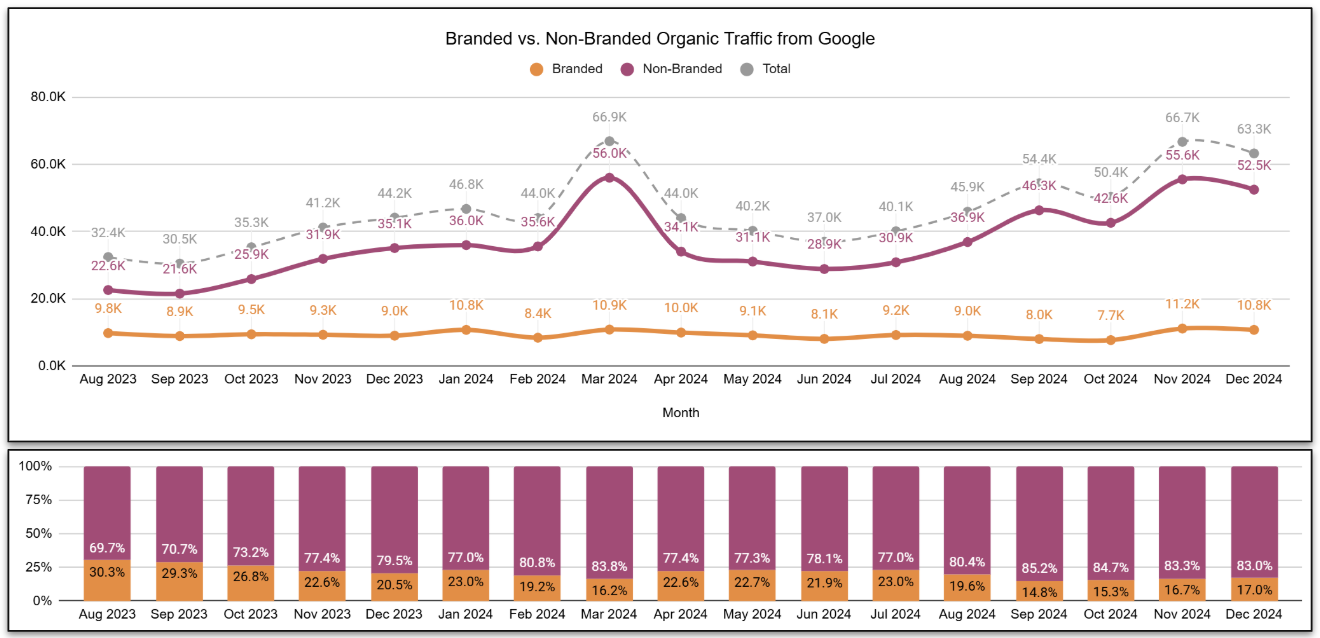
For medium-to-large websites, where there’s a significant gap between total clicks and sampled query clicks in GSC, a more reliable approach is to use the total click count and subtract branded clicks. This method ensures a more accurate estimation, particularly for larger websites where sampled query data may not reflect the full picture. Here’s how:
- Extract Total Clicks from GSC for a given period (without filtering).
- Extract Branded Clicks using a regex filter for all variations of the brand name.
- Estimate Non-Branded Traffic by subtracting branded clicks from total clicks:
Total Clicks − Branded Clicks = Non-Branded Clicks
Why This Method Works Better
- Branded queries are usually well-represented in the sample: Branded searches tend to have higher click volumes, so they’re more likely to be included in the sample.
- Accurate total clicks: GSC reports total clicks accurately, even though query-level data is sampled.
- No reliance on filtering: Subtracting branded clicks from the total avoids the issues introduced by query-based filtering and gives a more complete picture.
Key Takeaways
- Sampling in GSC leads to incomplete data, making it difficult to accurately calculate branded vs. non-branded traffic.
- Subtracting branded clicks from the total is a better method for estimating non-branded traffic, avoiding the pitfalls of query filtering.
- Understanding the split between branded and non-branded traffic is essential for refining SEO strategies and measuring brand performance accurately.
By following this approach, SEOs can gain a clearer understanding of organic traffic distribution and avoid being misled by the limitations of GSC’s sampled data.